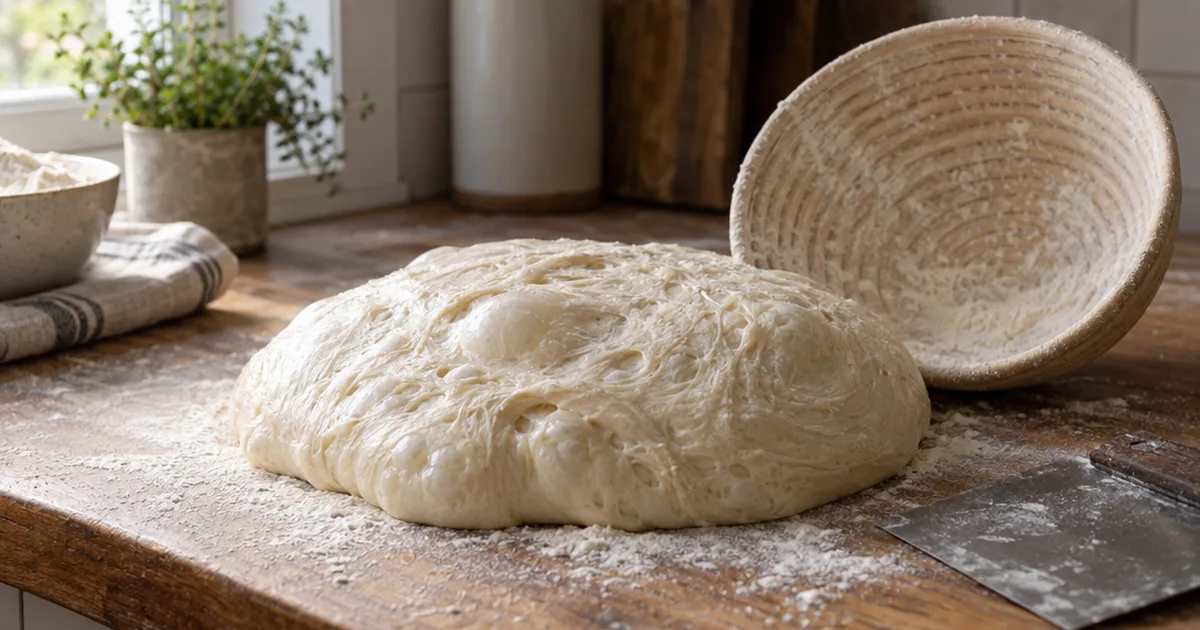

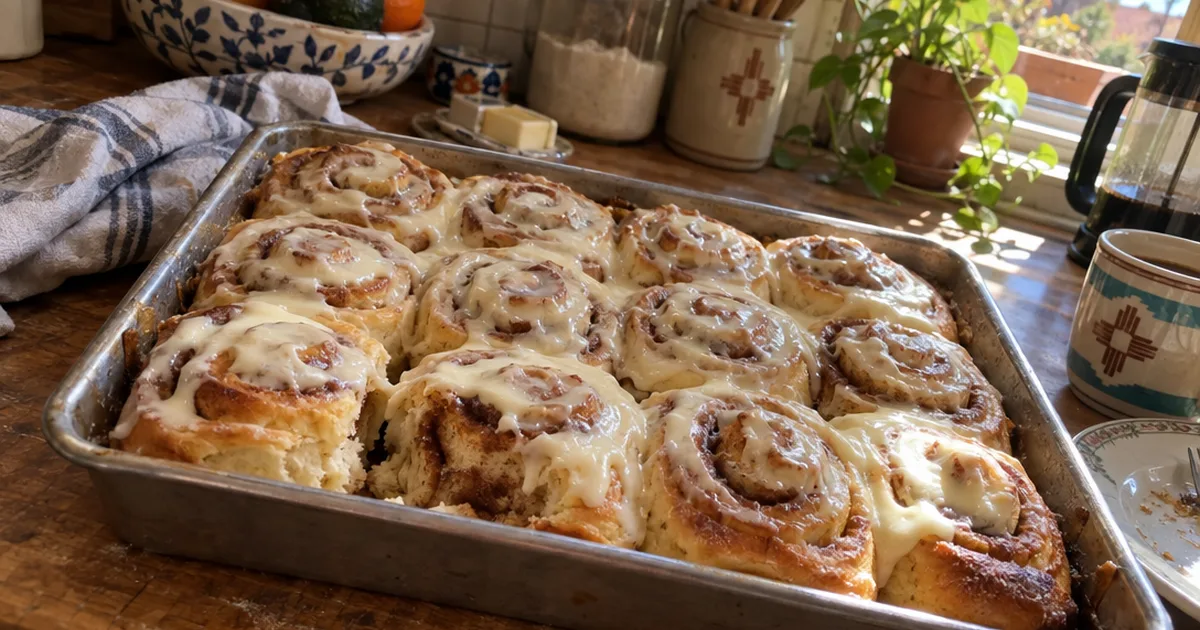
A batch of 12 cinnamon rolls can swallow 200 grams of sourdough discard.
That’s close to a cup of starter you’d otherwise pour down the drain.
This recipe turns it into soft, gooey cinnamon rolls with a light tang.
Below you’ll get the full sourdough discard cinnamon rolls recipe with weights, a same-day schedule, an overnight plan and a 1-hour version with no yeast at all.
Best for: anyone with a jar of discard and a free morning. Skip it if you have no starter yet.
Cost: pantry staples, plus discard you’d normally throw away.
Payoff: 12 rolls from one 9x13-inch pan.
Time: Same day (about 3 hours, or 1 hour for the quick version).
First step: Take your discard out of the fridge now so it warms up.
How to Make Sourdough Discard Cinnamon Rolls Step by Step
Sourdough discard cinnamon rolls take 8 steps: wake up the yeast, knead, let the dough double, fill and roll it, cut 12 rolls, let them rise again, bake at 350°F and frost.
This same-day method uses instant yeast for lift and discard for flavor, so plan on about 3 hours, most of it hands-off rising time.
Step 1: Warm the Milk and Wake Up the Yeast
Warm 120 g of whole milk to 100-110°F, which feels warm but not hot on your wrist.
Whisk in the instant yeast and a pinch of the sugar, then let it sit for 5 minutes.
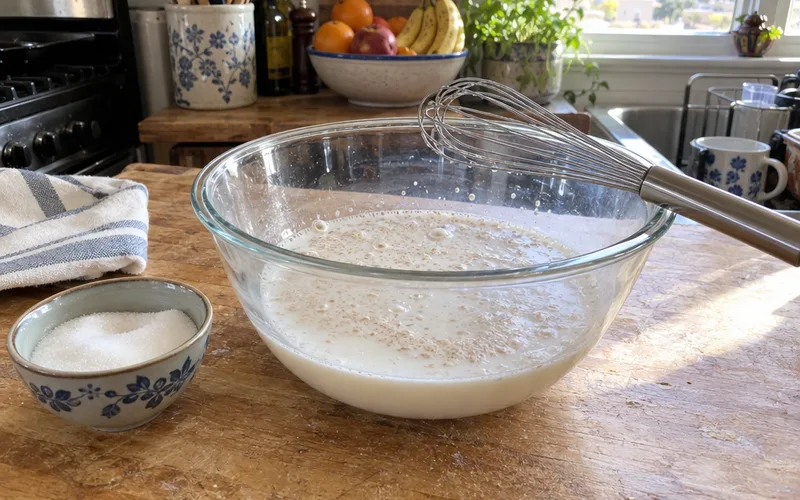
You’re looking for a little foam on top.
That foam tells you the yeast is alive, so a slow rise later won’t be a mystery.
Hot milk is the classic mistake here. Anything much past 110°F can weaken the yeast before it ever touches the flour.
Step 2: Mix and Knead the Dough
Add the discard, eggs, melted butter, the rest of the sugar, the salt and all but about 60 g of the flour.
Mix on low with the dough hook until it comes together.
Then knead on medium for 8 to 10 minutes.
By hand, it takes 12 to 15 minutes.
The dough is ready when it’s smooth, a little tacky and pulls away from the sides of the bowl. Add the reserved flour a spoonful at a time only if it still sticks everywhere.
Here’s why you hold flour back:
Discard hydration and flour brands vary, and too much flour is the fastest way to a dense roll.
Step 3: Let the Dough Double
Shape the dough into a ball and set it in a lightly greased bowl.
Cover it and let it rise somewhere warm until it doubles, usually 1 to 2 hours.
A kitchen around 75°F gets you close to the 1-hour mark.
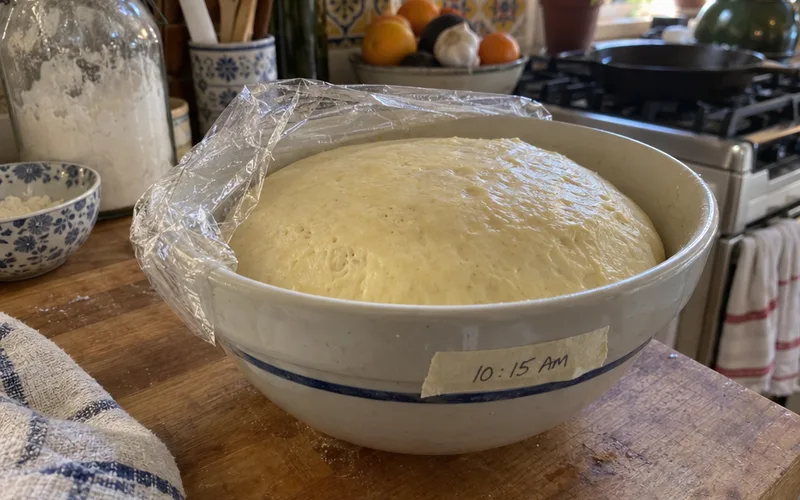
A cool kitchen pushes it toward 2 hours, and that’s fine.
So if your dough looks sleepy after an hour, give it more time instead of more yeast. The poke test for proofing bread works here too: a gentle press that springs back slowly means it’s ready.
Step 4: Make the Filling and Roll Out the Dough
Mix 85 g of soft butter with 150 g of brown sugar, 1 1/2 tablespoons of cinnamon and 1 tablespoon of flour until it forms a paste.
That spoonful of flour keeps the cinnamon roll filling from leaking out as the rolls bake.
Turn the risen dough onto a floured counter and roll it into an 18 x 12-inch rectangle, about 1/4 inch thick.
Keep the thickness even from edge to edge, so every roll bakes at the same speed.
Spread the filling all the way to the edges, except for a 1/2-inch strip along one long side. That bare strip is what seals the log shut.
Step 5: Roll, Seal and Cut 12 Rolls
Start at the long edge without the bare strip and roll the dough up tightly.
Pinch the seam closed and turn the log seam side down.
Now cut it into 12 equal pieces, each about 1 1/2 inches wide.
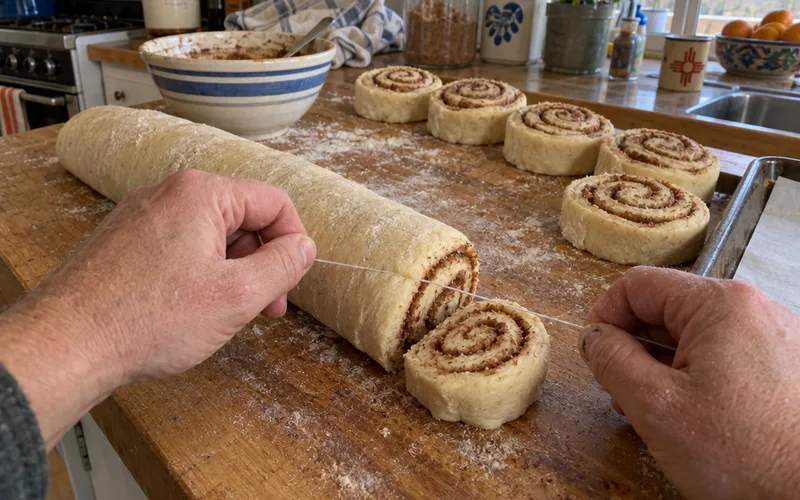
Unflavored dental floss makes the cleanest cut.
Slide it under the log, cross the ends over the top and pull. Unlike a knife, floss slices without squashing the spiral.
Step 6: Give the Rolls a Second Rise
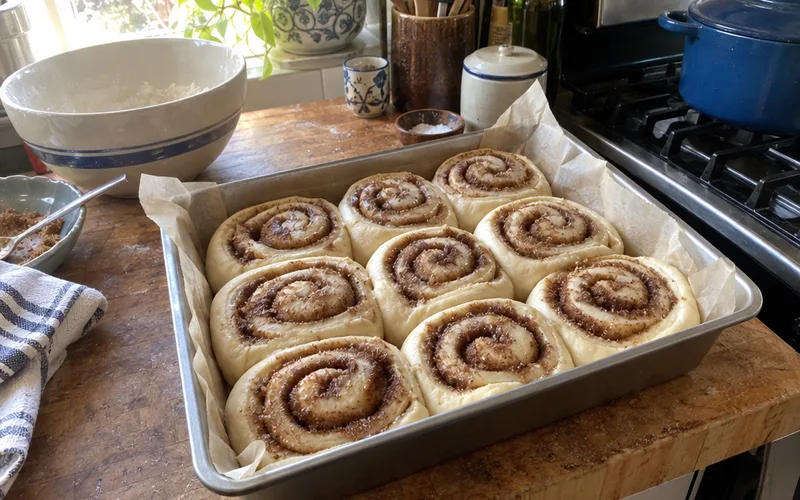
Line a 9x13-inch pan with parchment paper and set the rolls in, cut side up.
Leave a little space between them.
Cover the pan and let the rolls rise for 45 to 60 minutes, until they look puffy and just touch.
Preheat the oven to 350°F during the last 20 minutes.
Rolls set close together bake up softer at the sides, while rolls with more space keep a rounder shape and a firmer edge. In other words, the gaps you leave decide whether you get pull-apart rolls or neat individual ones.
Step 7: Bake at 350°F
Bake sourdough discard cinnamon rolls at 350°F for 25 to 30 minutes, until the tops turn golden and the center roll reads 190°F to 200°F on an instant-read thermometer.
For extra-gooey centers, warm 1/2 cup of heavy cream and pour it over the rolls right before they go in.
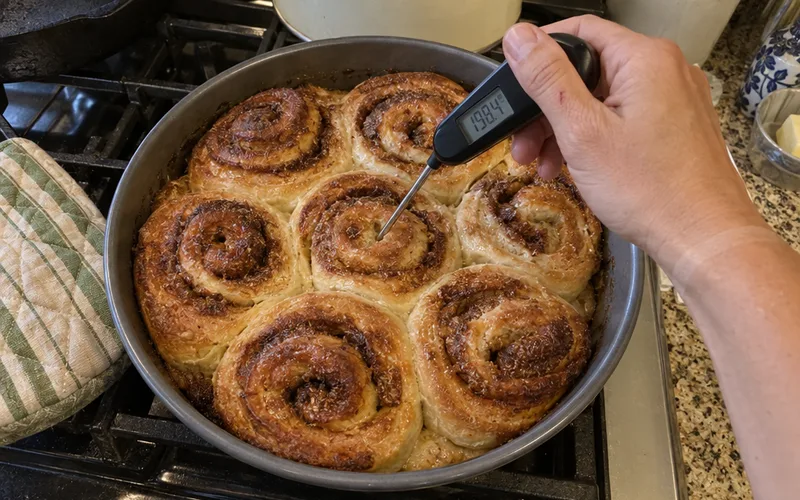
The outside browns before the middle finishes, so the thermometer beats your eyes every time. If the tops darken early, lay a sheet of foil loosely over the pan.
Step 8: Frost While Warm
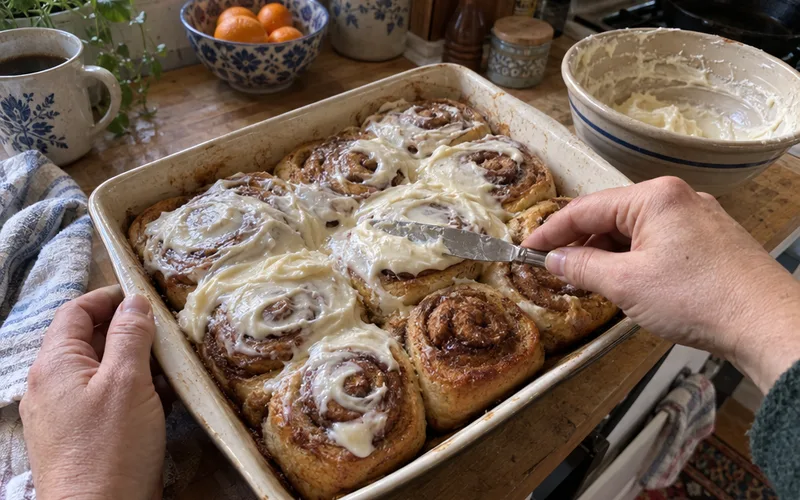
Beat 113 g of softened cream cheese with 57 g of soft butter until smooth.
Add 150 g of powdered sugar, 1 teaspoon of vanilla, a pinch of salt and 1 to 2 tablespoons of milk.
Let the rolls cool for 10 to 15 minutes first.
That way, the frosting melts into the swirls instead of sliding off.
Spread it on thick, and serve them warm.
What You Need to Make Sourdough Discard Cinnamon Rolls
Sourdough discard cinnamon rolls need 200 g of discard, bread flour, milk, eggs, butter, sugar, salt and instant yeast for 12 rolls, measured in grams because weight beats cups for flour and discard.
Here’s the dough:
- 120 g (1/2 cup) whole milk, warmed to 100-110°F
- 7 g (2 1/4 teaspoons) instant yeast
- 50 g (1/4 cup) granulated sugar
- 200 g (3/4 cup plus 1 tablespoon) sourdough discard, 100% hydration
- 2 large eggs, at room temperature
- 70 g (5 tablespoons) unsalted butter, melted and cooled
- 7 g (1 1/4 teaspoons) fine salt
- 420 g (about 3 1/3 cups) bread flour, plus up to 60 g more as needed
The filling and frosting use the amounts in steps 4 and 8.
Using bread flour for cinnamon rolls gives a taller, slightly chewier roll, while all-purpose flour makes it a little softer.
“100% hydration” just means your starter is fed equal weights of flour and water.
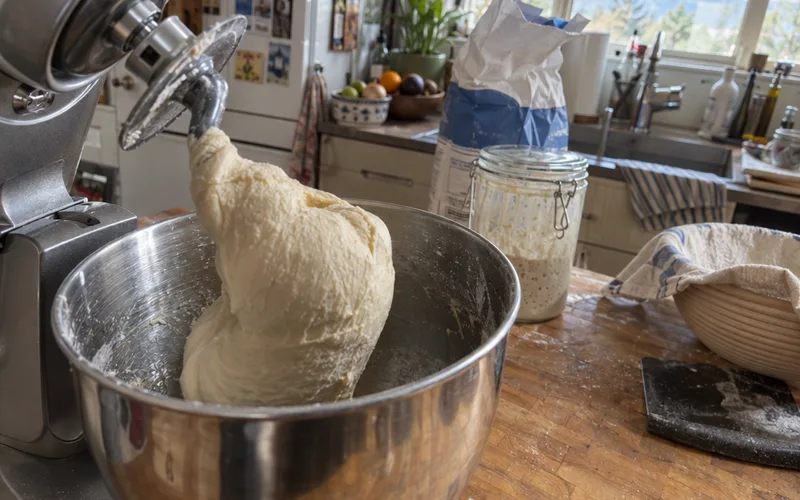
If yours runs thicker or thinner, adjust the flour by a spoonful at a time while kneading.
What Does Sourdough Discard Do to Cinnamon Rolls?
Sourdough discard adds a mild tang, extra moisture and a more tender crumb to cinnamon rolls, but it adds almost no rise on its own.
That’s why discard roll recipes pair it with yeast, or with baking soda and baking powder.
Discard is the unfed sourdough starter you pour off before each feeding.
You remove it so the starter doesn’t outgrow its jar, which is part of the routine for feeding a sourdough starter.
The freshly fed starter is what raises a sourdough bread recipe, while discard is the tired, acidic leftover.
So in a sweet dough, discard acts like a flavor and texture ingredient, not a leavener.
What does that mean for you? You can fold discard into a cinnamon roll dough without changing how the dough rises, as long as you count it as half flour and half water.
The tang stays in the background.
With brown sugar, butter and frosting on top, most people taste a richer roll rather than a sour one.
Cinnamon rolls are one of the sweetest sourdough discard recipes, and 200 g takes a big bite out of a crowded jar.
Do Sourdough Discard Cinnamon Rolls Need Yeast?
Sourdough discard cinnamon rolls need either yeast or baking soda and baking powder, because unfed discard can’t raise a rich, buttery dough by itself.
Each choice gives you a different roll.
Instant yeast gives the classic bakery texture: tall, fluffy and pull-apart soft. It needs two rises, so plan on about 3 hours.
Baking soda and baking powder skip the rising time completely.
The rolls bake right after shaping, but the crumb turns out denser, closer to a biscuit than a bread roll.
Want a roll raised only by sourdough? That takes active starter and a long ferment, which is a different recipe from this discard version.
No discard on hand? A cinnamon roll recipe with no yeast gives you the same quick, biscuit-style roll without it.
Same-Day, Overnight or Quick: Which Version Fits Your Morning?
Same-day sourdough discard cinnamon rolls take about 3 hours, overnight rolls move the rising to the night before, and the quick no-yeast version takes about 1 hour.
Pick by when you want to eat, not by which sounds easiest.
Here’s how the three versions compare:
| Version | Rises with | Total time | Texture |
|---|---|---|---|
| Same-day | Instant yeast | About 3 hours | Tall and fluffy |
| Overnight | Instant yeast | About 1 1/2 hours in the morning | Tall and fluffy |
| Quick no-yeast | Baking soda and baking powder | About 1 hour | Denser, biscuit-like |
So if you’re baking for a holiday morning, the overnight version does the slow part while you sleep.
If you decide at 9 a.m. that you want rolls by 10, the quick version is your only real option.
A Sample Same-Day Schedule
A same-day batch fits neatly into a weekend morning if you start by 8 a.m.
Here’s what the clock looks like in a kitchen around 75°F:
- 8:00 a.m. Warm the milk, mix and knead the dough (about 20 minutes).
- 8:20 a.m. First rise, until doubled.
- 9:30 a.m. Roll, fill and cut the rolls (about 15 minutes).
- 9:45 a.m. Second rise in the pan; preheat at 10:10.
- 10:30 a.m. Bake for 25 to 30 minutes.
- 11:00 a.m. Cool, frost and serve.
A cooler kitchen can add an hour to the rises.
So if guests arrive at a fixed time, build in that cushion or switch to the overnight version below.
How to Make Overnight Sourdough Discard Cinnamon Rolls
Overnight sourdough discard cinnamon rolls are shaped the night before, chilled in the fridge for up to 12 hours, then warmed up and baked in the morning.
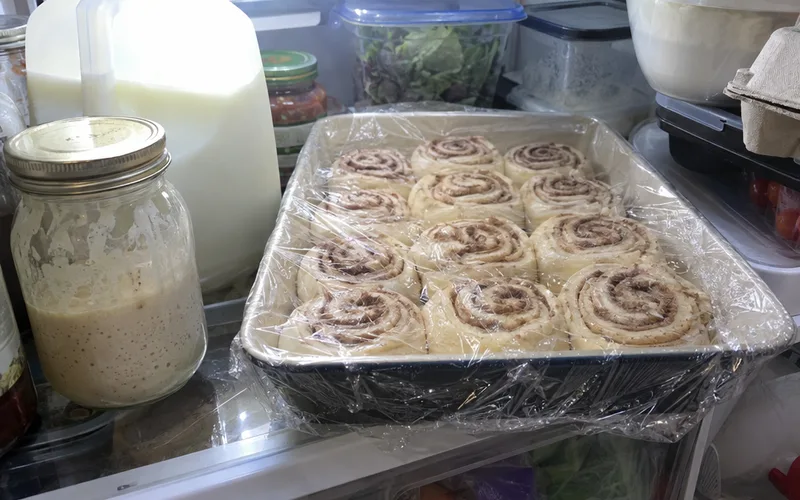
The cold slows the yeast, so the rolls rise gently while you sleep.
Here’s how it works:
- Follow steps 1 to 5 the evening before, then set the cut rolls in the lined pan.
- Cover the pan tightly with plastic wrap and refrigerate it right away.
- In the morning, leave the pan on the counter for 45 to 60 minutes, until the rolls look puffy.
- Preheat to 350°F and bake as usual, adding a few minutes if the centers are still cool.
Cold rolls need that counter time.
If they go into the oven straight from the fridge, the outsides brown long before the middles cook.
There’s also a no-yeast overnight method.
Mix the quick dough below without the baking soda and baking powder, cover it and leave it on the counter for 10 to 12 hours in a 68-70°F kitchen. In the morning, knead in the leaveners, shape and bake right away.
Keep an eye on warm nights. Above about 75°F, cut that counter time to 7 or 8 hours, or the dough turns slack and sticky, the same problem behind overproofed sourdough.
So which overnight method should you pick?
Choose the chilled yeasted rolls if you want the tallest, fluffiest result, and the counter-fermented quick dough if you want the least work in the morning.
The quick dough skips the morning rise entirely, so you’re eating about 45 minutes after you get up.
Quick 1-Hour Sourdough Discard Cinnamon Rolls (No Yeast)
Quick sourdough discard cinnamon rolls skip yeast and use baking soda and baking powder, so they go from mixing bowl to frosted rolls in about 1 hour.
This is the version for a last-minute craving.
Here’s the dough:
- 420 g (3 1/2 cups) all-purpose flour
- 1 1/2 teaspoons baking powder
- 3/4 teaspoon baking soda
- 3/4 teaspoon fine salt
- 200 g sourdough discard
- 200 g (3/4 cup plus 1 tablespoon) milk
- 85 g (6 tablespoons) unsalted butter, melted
- 60 g (3 tablespoons) honey
Preheat the oven to 375°F first.
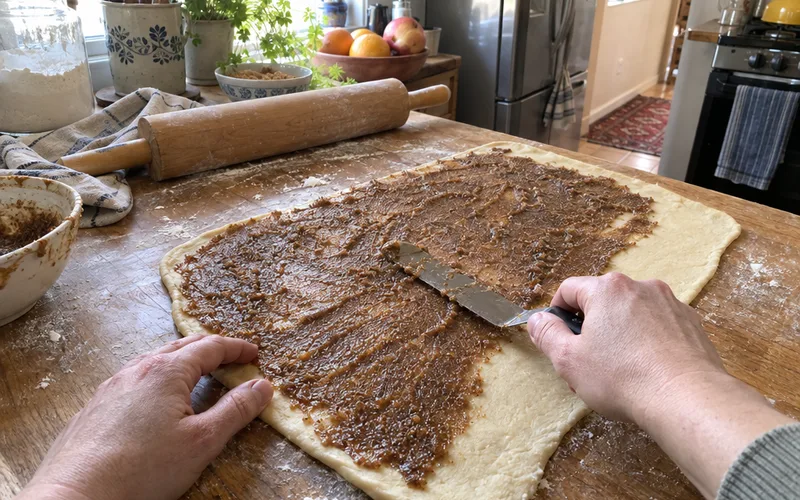
Whisk the dry ingredients, add the wet ones and mix for 3 to 5 minutes, until a soft ball forms.
Then roll, fill and cut exactly as in steps 4 and 5.
Bake for 25 to 30 minutes, until golden and cooked through in the center.
The acid in the discard reacts with the baking soda, which helps the rolls puff in the oven. Because that reaction starts as soon as the dough is wet, don’t let the shaped rolls sit around before baking.
Can You Use Sourdough Discard Straight From the Fridge?
You can use sourdough discard straight from the fridge for cinnamon rolls, but cold discard chills the dough and slows the yeast, so the first rise can take noticeably longer.
There are two easy fixes.
Set the discard on the counter for an hour or two before you start.
Or use milk at the warm end of the 100-110°F range to make up for the cold discard.
Either way, judge the rise by size, not the clock.
Doubled dough is ready dough, whether that took 1 hour or 2.
For the quick no-yeast version, cold discard barely matters. There’s no yeast to slow down, so mix and bake as written.
Can You Use Active Starter Instead of Discard?
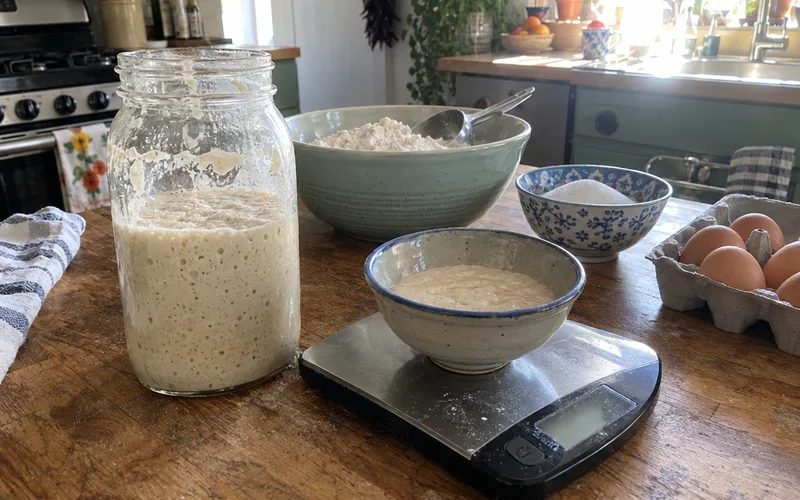
You can swap active sourdough starter for discard in these cinnamon rolls gram for gram, and the dough will rise a little faster because fed starter still has lively yeast.
Use the same 200 g of active starter, and keep the 7 g of instant yeast in the recipe.
Active starter on its own needs many hours to raise a dough this rich in butter and sugar.
So the swap changes the flavor and speed slightly, not the method.
Expect a milder tang, since fed starter is less acidic than old discard.
Don’t have a starter yet? Making a sourdough starter takes only flour, water and patience, and every feeding after that gives you discard.
Why Your Sourdough Discard Cinnamon Rolls Aren’t Rising
Sourdough discard cinnamon rolls usually fail to rise because the dough is too cold, the yeast was damaged by hot milk, or too much flour went in.
The fix depends on which one it is.
Here are the four most common causes:
- Cold dough. Fridge-cold discard, eggs or butter can stall the first rise. Move the bowl to a warmer spot and wait.
- Hot milk. Milk well above 110°F can weaken the yeast. Next time, check it with the thermometer.
- Too much flour. A stiff dough rises slowly and bakes dense. Hold back flour and stop when the dough is tacky, not dry.
- Old leaveners. In the quick version, old baking powder or baking soda gives a flat roll. Replace them if they’ve been open a long time.
Not sure if the rolls are ready for the oven? Press the side of one gently.
If it springs back right away, give it more time. If it stays dented with just a little spring, bake.
Tips for Softer, Gooier Sourdough Discard Cinnamon Rolls
The softest sourdough discard cinnamon rolls come from a slightly sticky dough, a tight roll and a pour of warm heavy cream right before baking.
Small choices add up here.
- Roll thinner for more swirls. A 1/4-inch sheet gives you more layers of filling than a thick one.
- Cut evenly. Small rolls bake faster than large ones, so uneven cuts leave some dry and some doughy.
- Tuck the ends. Wispy pieces at the end of the log go under the roll, so it bakes into a neat spiral.
- Add mix-ins last. Raisins or chopped pecans go on top of the filling, before you roll the log.
Mix-ins can make the spiral open up a little in the oven.
That’s a looks problem, not a taste problem, and the frosting covers it.
Bigger Rolls, Smaller Batches and Pan Swaps
Sourdough discard cinnamon rolls adapt to almost any pan: cut 12 for a 9x13-inch pan, 8 large ones for a 9-inch round, or halve the recipe for 6 rolls in an 8-inch pan.
Only the baking time really changes.
Want 8 bakery-size rolls? Cut the log into 8 pieces and bake them in a 9-inch round pan for about 5 minutes longer.
Those bigger rolls carry more butter and sugar each, so homemade cinnamon roll calories climb with roll size.
For a small batch, halve every ingredient and use 1 egg.
Roll the dough into a 9 x 12-inch rectangle, cut 6 rolls and bake them in an 8-inch pan, starting to check at 22 minutes.
A 12-inch cast iron skillet also works well for a full batch of 12.
It holds heat evenly and gives the outer rolls crisp, caramelized edges.
Glass pans heat more slowly than metal, so rolls in glass often need a few extra minutes. Line glass with parchment, and judge doneness by the 190°F to 200°F center, not the clock.
How to Store Sourdough Discard Cinnamon Rolls
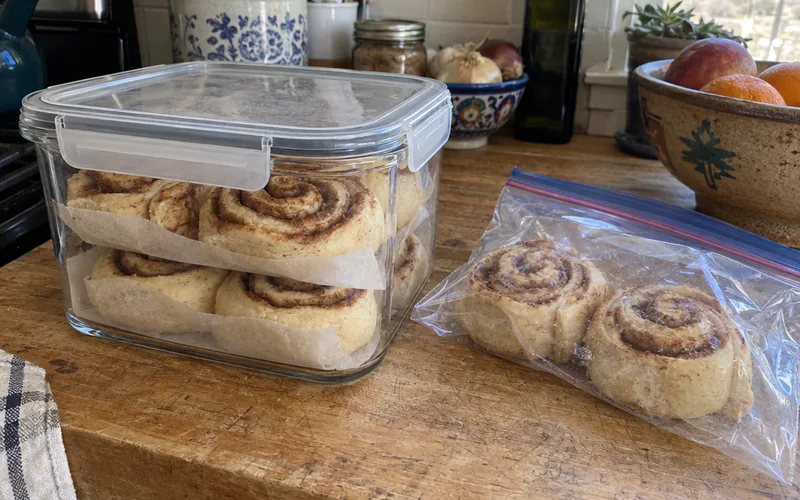
Unfrosted sourdough discard cinnamon rolls keep at room temperature for about 2 days in an airtight container, while frosted rolls belong in the fridge because cream cheese frosting is perishable.
Room temperature is fine for plain rolls.
Once the cream cheese frosting goes on, the rules change.
The U.S. Food and Drug Administration’s two-hour rule says foods that need refrigeration shouldn’t sit out for more than two hours, or one hour when it’s above 90°F.
So after brunch, put frosted leftovers in a covered container in the fridge.
The FDA also advises keeping your refrigerator at or below 40°F (4°C), which is worth checking with an appliance thermometer.
Before you eat a leftover, give it a quick look.
The FDA notes that mold can grow even under refrigeration, and the safest move is to throw moldy food out.
To bring a cold roll back to life, warm it in the microwave for 20 to 30 seconds.
How to Freeze Sourdough Discard Cinnamon Rolls
You can freeze sourdough discard cinnamon rolls baked or unbaked, and baked, unfrosted rolls are the easiest to freeze and reheat later.
Frosting is best added fresh after thawing.
For baked rolls, let them cool completely, then pack them in an airtight container or freezer bag with parchment between layers.
The U.S. Food and Drug Administration says food kept at 0°F (-18°C) stays safe indefinitely, but its quality drops the longer it sits.
So aim to eat frozen rolls within about 2 to 3 months, while they still taste fresh.
Dry, leathery spots mean freezer burn.
The agency calls that a quality issue, not a safety one, and tight wrapping prevents it.
For unbaked rolls, freeze them right after cutting, in a lined pan wrapped in plastic and then foil. Thaw them in the fridge overnight, let them rise on the counter until puffy, then bake as usual.
To reheat baked rolls, thaw them and warm them at 350°F for about 10 to 15 minutes, then frost.
Frequently Asked Questions
Can I add sourdough discard to any cinnamon roll recipe?
Yes, you can add sourdough discard to most yeasted cinnamon roll recipes if you treat it as half flour and half water. For 200 g of 100% hydration discard, cut about 100 g of flour and 100 g of liquid from the original recipe, then keep the yeast.
Can I make same-day sourdough discard cinnamon rolls?
Yes, same-day sourdough discard cinnamon rolls take about 3 hours with instant yeast, most of it hands-off rising time. The no-yeast version is faster still, at about 1 hour from mixing bowl to frosting.
What is an easy recipe for cinnamon rolls?
The easiest sourdough discard cinnamon rolls are the no-yeast kind, leavened with baking soda and baking powder instead of yeast. You mix the dough for 3 to 5 minutes, roll and fill it, and bake at 375°F with no rising time at all.
How long are cinnamon rolls good for after the expiration date?
Store-bought cinnamon rolls are often still fine shortly after their date, because the FDA says a use-by date marks best flavor or quality, not food safety. Still, throw out any roll that shows mold or smells off, whatever the date says.
How do I know when sourdough discard cinnamon rolls are done?
Sourdough discard cinnamon rolls are done when the tops are golden and the center roll reads 190°F to 200°F on an instant-read thermometer. Color alone can fool you, because the outside browns before the middle finishes.
Can I use active dry yeast instead of instant yeast?
Yes, active dry yeast works in sourdough discard cinnamon rolls at the same weight, but dissolve it in the 100-110°F milk with a pinch of sugar first. Wait 5 to 10 minutes until it foams, then carry on, and expect the first rise to run a little longer.
Can I use all-purpose flour instead of bread flour?
Yes, all-purpose flour works in sourdough discard cinnamon rolls gram for gram. The rolls come out a little softer and less tall than with bread flour, so hold back some flour and add it only if the dough stays very sticky.
Final Thoughts
Sourdough discard cinnamon rolls are one of the best ways to use up a jar of discard, because 200 grams disappears into a single batch.
Pick the version that fits your morning: same-day with yeast, overnight in the fridge, or quick with baking soda and baking powder.
This week, pull your discard out of the fridge an hour before you start, and bake the same-day batch first.